Slice and Dice rules
I enjoy the occasional roguelite*. But they fall broadly into two categories for me: complex and engaging but also long and taxing, or delightfully short but with less meaningful depth. If only there was something with the lean agility of a tight, expertly designed board game, but also leveraging the randomness and zero setup of a video game without sacrificing said design.
Even if it’s a tall ask, something more compact that doesn’t trade off its strategic depth. Something modular, but where reading and keeping track of all the effects is somehow still easy. Something that has a free demo I could download and play right now, and if I really liked it could purchase once and own forever without ever seeing in-app purchases again. Maybe it could even work on mobile?
Wait, it exists? It works great in portrait and landscape? Great art direction and music too? Almost no battery drain? Gamemodes? Less than 10 dollars??** Mod support on mobile and cross platform progress sharing?? Wow, I gotta get on this, and then write an excruciatingly long post about it.
Which is exactly what I did, but the kicker is that I’ve actually started playing a few years ago. I just keep coming back to it. For me this is as close to flawless as you can get. It has everything. This post is not going to be a review or something, it’s just me blasting a wall of text about why Slice & Dice rules. It’s developed by only one programmer and genius, tann, and made beautiful by pixel artist a3um.
This will contain some unlock spoilers as you go on, so if at any point you want to quit reading so you can play at this very moment, please do. In fact, if this post achieves anything, let it be you trying out Slice & Dice.
*Also known as roguelikes these days, but I firmly reserve the term for games that are like the 80’s video game, Rogue. Nethack is a roguelike. Slay the Spire deserves its praise but it doesn’t play like Rogue.
**The price on itch.io is higher because it contains both the desktop and Android versions.
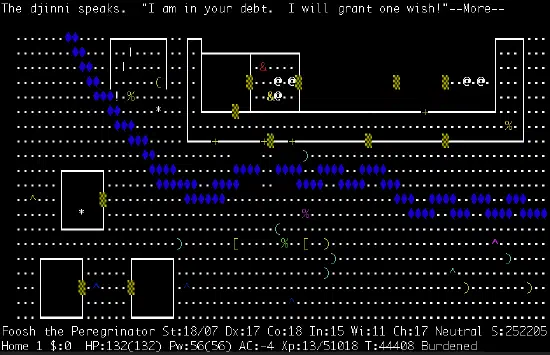
A capital-R Roguelike. Screenshot via Wikipedia's Nethack page.
Basics#
It’s helpful to know what the game plays like if you haven’t played it before (you really should, though). You can skip this if you’ve played the game already.
The short version is this:
- All your enemies roll dice and pick their targets.
- You roll all your dice.
- You can lock in dice and reroll up to 2 times, or finish rolling.
- You use all of your dice and end your turn.
- Your enemies use all their dice, following their attack plan established at the start.
- Repeat step 1-5 until either you or the enemies are wiped out.
In the classic game mode (more on the modes later) you have 5 characters, and there’s 20 battles to beat the game. As you make it through every battle, you alternate between a character level-up and an extra item to equip. If you don’t like your choices, you can skip them - or leave it up to chance and pick the third option, which is a completely random level-up or item of the appropriate tier (variety!)
Characters each have one 6-sided die representing their class, and each face has an ability on it, like a basic attack or shield, healing or mana gain (or nothing at all). Most of the faces have an amount of pips (effectiveness, so the amount of damage or shield or healing or mana you’d get) if applicable. Some faces prevent death or let another character use their dice again, those have no pips.
Before you get to roll your dice, your enemies rolled all of theirs, and selected their targets. You already know who’s gonna get hit by what, and for how much. Now it’s your turn, and all of your dice roll. With pretty satisfying physics, too. You get 2 rerolls, and you can lock dice to prevent them from rerolling. This gives you a feeling of freedom right out of the gates - you can try to push for maximum damage, but often you have to take the best you can get.
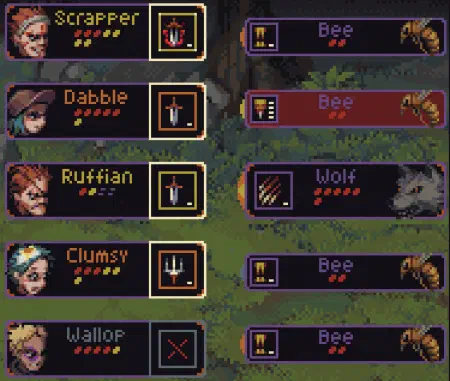
Note that the interface is easy to read, despite 10 onscreen entities: you can see how much damage you're going to take, that the red-flashing Bee will die, and that we have about 4 damage to work with. Target colors are on the left sides of the enemies, but you can hold a button to draw lines between enemies and their targets, too.
Readability is big in Slice & Dice - it’s what makes processing complex scenarios so frictionless. Not sure what a die does? You can hold it, or its associated character, and read all of its effects. Want to see everything your party can do? The inventory screen shows all your dice and items simultaneously, everything relevant to your whole run - and it all fits in a single phone screen without being overwhelming. This makes the mental processing much more streamlined, as you don’t have to take a break to keep track of a few separate screens, like a stat page or a deck.
You could jump into someone else’s save file and know what you’re working with in mere seconds. This actually happens too! In the Slice & Dice Discord, you see people copy/pasting their save (this works cross-platform!) and asking if that round was actually impossible or not. It usually isn’t - seasoned players boast a normal mode winrate exceeding 90%. (I am not seasoned players.)
What’s also immediately noticeable is that the pips on the dice, and the HP counts, are all fairly low. This makes the difference between 1 and 2 pips meaningful, and items that flat-out increase those pips highly valued. In fact, items that do so without drawbacks don’t even appear for the first half of your run. Over time, you come to appreciate just how finely tuned these numbers are.
After all the dice are rolled and locked, you select your characters/dice rolls and a target for it. Attacks go on enemies, shields and healing go on allies, you get the idea. As you’re selecting your first targets, you also make a humble first contact with the backbone of the game: keywords.
There are 3 things that work together to make Slice & Dice so versatile and timeless: Keywords, spells, and its enemy design. The core mechanics are lean. The combat round is straightforward and easy to process even as the battles become more dense and chaotic. Because of this, the game gets to be very flexible with these three points and how they fit into the combat.
While this gets increasingly complex, the game’s unlock system is tied to ingame achievements, such as reaching a certain battle, winning a few fights, beating the game, dying a few times and more. The significant unlocks happen early and naturally, and the game eases you into its more complicated classes, items and enemies. Every time you feel comfortable and familiar with your current options, your possibilities quickly broaden. By the time you get any unlock, you’ll quickly understand its implications.
Keywords#
You may be familiar with keywords from TCGs - one or more words listed on a card that imply certain effects. Slice & Dice has loads of them. They’re on most dice, and items will add or modify them. Spells haev keywords. Some enemies will inflict keywords. There’s keywords that modify other keywords. And of course, keywords stack. The basic keywords tell you what kind of threats you can expect:
- Enemies can be on the back line, which you can’t attack while there’s enemies on the front line. Unless your attack has
ranged. - Some dice sides are more powerful, but come with drawbacks.
heavyforces you to target the highest HP enemy.painalso deals damage to the user. Using anexertside leaves you unable to use that die the next turn. Sometimes you’ll be reined in bydeath, which straight up kills you when used. - The above keywords may just as well be on shield or healing sides.
cantripis especially cool; just rolling that side will automatically trigger it during rolling. This adds additional risk/reward during rolling, and even enables entire setups around rerolling. You can win before even taking your turn.- Its negative version is
sticky, preventing further rerolls for that die if it lands on astickyside. - There’s
poisonandregen, which damage or heal over turns, and stack. cleanseremoves (or prematurely wards against) negative status effects, which can be a slow threat likepoison, or something truly devastating likeweaken(reduces your pips) orpetrify(locks up sides on your dice).cleavehits the target and both adjacent enemies;descendhits the target and the enemy below it. This tells you the enemy positions are important, too.- Some keywords have a
selfvariant (selfshield,selfheal,selfcleanse) giving the user that effect in addition to what the die’s side normally does.
Keywords would normally be difficult to keep track of, but the common combinations of effects and keywords that appear on characters come with unique sprites, and that makes all the difference. X damage is a simple dagger, but X damage pain is a red sword. X damage selfshield is a sword and shield. X damage selfheal is a sword and heart.
X damage cantrip? Purple dagger. X selfdamage cantrip? Purple caltrop.
Sprites generally incorporate the unique colours of the keywords to further ease the visual processing. That trident/pitchfork you see in the previous screenshot is 1 damage cleave, with 3 teeth to symbolize the 3 enemies it hits. Naturally, 1 damage descend has 2 teeth. The visual language is logical and consistent. Fantastic.
As you descend, you’ll notice more and more that hardly any keywords are straight up powerups. They tend to have some sort of condition to them, something unique to look for in the battle. Having certain keywords means you could be playing the battle very differently. Consider the following, which all give x2 damage, but only under specific circumstances:
cruel, on targets at or below half HPengage, on targets with full HPfocus, if the previous die targeted the same enemyunderdog, if your target has more HP than you- naturally, there’s also a keyword if your target has less HP, logically called
overdog. This is granted by the item Updog. - naturally, there’s also a keyword if your target has equal HP, logically called
dog chain, if it shares any keywords with the previous diepair, if it has the same number of pips as the previous dieduel, if you’re attacking an enemy that’s targeting you onlytrio, which is actually x3, but only if it has the same number of pips as the 2 previous dicedeathwish, if the user would die that turn
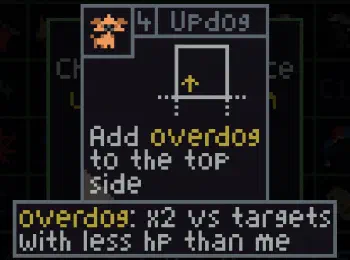
The venerable Updog.
Any of these will have you looking for something different. If you have engage, landing it in the beginning is cause for celebration, but you may later pass on it. focus means committing harder to one target. If you get a trio and one matching die, you may find yourself rerolling for that second matching die for its maximum potential. With underdog, you may even consider damaging your own party members. The existence of chain can have you picking a levelup you wouldn’t otherwise choose to synergize with it. I’ll spare you from getting into the strategic opportunities of rampage and rescue, you gotta play the game for that. This post is already way too long.
The plethora of keywords is combined with apt naming to add great flavour to all the game’s distinct classes. Take Clumsy, who has an egg on their head in their portrait, with two 1 damage cantrip sides (cool!) but also two 1 self-damage cantrip sides in addition to very low HP, with a fittingly high risk of killing themselves before the attack phase. They also come with two 1 damage cleave sides, which you can easily imagine to hit multiple enemies by accident.
Hoarder, who comes with 6 different weapon sides on account of hoarding, has higher damage on average but mastery of none, as every side has a drawback.
The self-sacrificial Cultist, who has mostly managain pain sides to quickly fuel your spells, and two singleuse selfheal sides to replenish themselves off some other unfortunate target.
The glorious Gladiator, with selfshield and engage , is practically itching to get at the enemy.
Each class has a specific and clear focus, and their names and sprites perfectly encapsulate what you can expect out of them. Every side feels so carefully considered, and comes together to have the complete die tell a story about the character.
All the earlier-game classes and items tend to have downsides to their power. The later-game classes generally don’t, like the Valkyrie which can prevent characters from dying or resurrect fallen ones. Venom boasts a ranged poison attack and one side where the power is dependent on how much combined poison your enemies have.
As for storytelling, Dancer may not be the most powerful, but comes with “1 damage to all enemies rampage pain”, which means you can use it again if it kills an enemy, but also hurts the Dancer for that much. So if you get your enemy HPs lined up correctly, you can clean off the whole field. Their other sides are Gain 1 reroll cantrip, 1 damage cantrip, 4 damage and Dodge all damage and enemy effects this turn. It gives you the feeling of weaving through the roll phase, then either striking hard or dodging, if the rolls allow it. Very fluid, I love that. I had a run where an item added deathwish to all the Dancer’s sides, so every time they got attacked it felt like a “last dance” kind of situation. It felt dramatic to hit the rampage pain side, now with 2 pips, melting both the enemy team and the Dancer themselves, who already had no hope of survival.
The classes feel well-rounded, and complete. But leveling up just replaces a class with a higher tier class, each with their own complete dice. If we want to change anything about them, that’s where items come in.
Items#
Items mostly do one of two things: replace dice sides or add keywords to existing sides. Every character can equip 2 items. Because items also add keywords, you get many opportunities to cook up something crazy. But keywords, especially more powerful ones, don’t usually get added to all sides; a part of the item’s balancing is exactly which sides the keyword gets added to. Most classes have weaker attacks or no attacks at all on the right side of a die, and is thus considered less valuable by items. And higher value means they only show up later in the game. But a lot of items will have a powerful keyword on just one or two sides, so it may appear in the midgame.
Take the Agent, who has two 1 damage quaduse sides, so 4 damage in total. You can simply boost them with the Fey’s Heal 1 boost, which would give you a whopping 8 damage to work with. If you run into the later-game item Poison Dip (adds poison to the two left sides), one of those quad daggers can apply 4 poison total. If you can get both off, that’s 8 damage and 8 poison. Got the mid-tier item Tie, which adds pristine to the middle side (x2 if user has full HP)? You could be looking at enough damage to annihilate the endgame bosses in 1-2 turns.
But you have many more options at your disposal. There’s sides that have 1 reroll cantrip, which gives you an extra reroll when it lands. Do you have multiple of those? Can you increase their pips for even more rerolls? Maybe you can go for a cantrip-laden party and melt the other side before you even have to use a die yourself. (There’s an ingame achievement for that.)
Items are also flexible. After every battle, you’re free to move them around as you see fit. And this is necessary - what if your Tie holder died last turn? They’ll have half HP now and won’t benefit from pristine. You can heal them, or swap off the Tie to someone else. Sometimes, a level up will drastically alter the sides in a way that makes an item useless for them. If your character’s middle side becomes a pip-less ability, the Tie should go to someone else. So you’re picking items with that in mind, too.
Since items let you stack keywords, you end up with more interesting effects. You can add managain to your +1 reroll side. growth on a multi-use or cantrip side, stacking its value at incredible speeds. Candle adds vigil to all sides, +1 pip for each defeated ally, on top of all the keywords you already had.
There’s some fun green-color classes that change up items a bit like Robot, which has 2 extra item slots (and sides like Shield 1 repel rampage rescue and Heal 1 boost inflictpain). Or Twin, who has a copy of themselves that shares all of their items. This gives you a total of 6 characters. What kind of setups can you make then?
With 470 items built in(!) and thousands more being possible due to random generation(!!), there’s also a ton of fun novelty effects. Copy the middle side onto the left side. +1 to incoming shields. Replace blank sides with something useful. Later tier items come with the more outrageous effects - set all sides to 2 (could be a negative!), add selfshield to all damage sides, double the pips of the left side, gain the effects of all items in a specific tier that other heroes have equipped, or an unreliable one-off like Chaos Wand, replacing the middle side with 1 damage singleuse cleave engage selfheal weaken vulnerable.
Or you can run into things that drastically increase your mana gain, like an item that adds era to all mana/managain sides, increasing their value by 1 every turn. Fairy Dust, replacing all blank sides with +3 mana. Maybe you’ll be casting a million spells. Spells?
Alright, we gotta talk about spells.
Spells#
If by this point you already think “wow, that sounds wild, I should check this out” (you should) then you’re not actually gonna see spells yet. The game’s classes are divided between 6 total class colors:
- yellow (physical damage, fighters, berserkers, oddball weapon collectors,
fleshand blood) - grey (shields/protection and some healing/cleansing, think paladins, monks, knights, armor and
steel) - orange (high damage, squishy, lots of trickery, archers and rogues,
rangedandengage) - red (healing, selfheal, cleansing, some mana gain, healers, witches, druids, vampires,
cleanse,growth) - blue (firmly magical, wizards, warlocks, jesters, mushroom mages,
managainand various support effects) - green (miscellaneous mystery box with interesting effects that don’t fit elsewhere, unique characters - a housecat, a spade, a statue, a coffin?)
Out of these, you only start off with the first 3 (yellow/grey/orange). You get red and blue pretty early, for defeating the 4th fight, which is your very first boss battle. Since you managed that, you understand the basics, and you unlock something more nuanced or complex as a reward. In this case, spells, since they only show up in the UI if you have (dice with) mana, and until now you didn’t have a source of mana. Spells have a few rules:
- Your spells are a separate bar from your dice
- You always have the spell Burst, which costs 2, and can either be used as 2 shield (allies) or 2 damage (enemies)
- All other spells are tied to certain (red and blue) classes or equipped items, and require that character to be alive if you want to cast them
- You can only keep 3 mana max at the end of the turn, anything more is lost at the end of your turn
This already has a bunch of cool implications, positive and negative:
- Burst sounds basic, but is highly flexible. It can be used more than once per turn
- Most spells can be used more than once, unless otherwise stated
- Of course, spells also have keywords
- But they can’t be targeted by dice, and thus not boosted like characters
- You must account for keeping certain squishy characters alive for access to more powerful spells
- While capped, you can carry mana over between turns, so you can empower your next turn instead of bursting until you’re out of mana
- Your spells aren’t affected by your rolls, if you have mana you can cast it
- Maybe there’s enemies that interact with this mechanic too? (yes)
The spells add a layer of strategic depth that’s always there for you even if your rolls have let you down. Starting spells like Poke (1 mana, 1 damage cooldown) that you can only use once per turn or Slay (3 mana, kill an enemy with exactly 3 hp) eventually make way for powerful options like Miasma (3 mana, 1 damage poison cleave) and Liquor (3 mana, Heal 10 cleanse). Foretell (3 mana, +4 mana future) gives you +4 mana the next turn, which is one of the ways around the 3 mana stockpiling limit. Between spells and rerolls, the cursed roguelite “one bad draw ending your game” is not impossible, but much less likely.
There’s also the existence of Tactics, which work like the yellow/grey class equivalent of spells, but instead consume broad categories of unused dice. Got damage but needed shield? Maybe the Knight’s Parry can help you out, by using up any 2 damage pip sides to give you 3 shield. Tactics are rarer and often less valuable than the dice themselves, but they can give you yet another way to deal with a hopeless situation. Sometimes, you have no other choice, and your Tactic has you praying you come up with some blank sides.
At this point it sounds like you have practically infinite options at your disposal. And you kind of do. But your plethora of options is kept in check by some amazingly designed enemies.
Finally, enemies#
It wouldn’t do to just build massive damage and melt through everything. That’s why the game offers you close to 70 monsters, including bosses. These all offer some distinct threats to every fight they’re in, and every threat counters some specific strategy you may have. And many of them come with distinct weaknesses - instead of just giving you a bunch of extra downsides to deal with, the enemy may also have a massive (and thematically fitting) downside of its own. This makes dealing with them a lot more rewarding, since you’ll want to exploit that weakness however you can, leading to vastly different priorities depending on the monsters involved. And like the classes, enemies also have names and die sides that tell a story.
Early on, you’ll see this in Skeletons. They have fairly strong attacks compared to their peers, but defeating one deals 1 damage to both adjacent monsters, as if their bones explode into shrapnel upon their defeat. This makes up for the extra damage they deal. You see it in Bees, weak enemies that appear in larger numbers, but they come with one disproportionately strong attack that also kills them. The game gives that one the icon of a stinger, which I love. In Thorns, which only have 2HP, but are immune to magic and deal a whopping 5HP of on-hit damage, and require a ranged attack or a big amount of shields. And Illusions, 1HP buggers that significantly weaken your party in larger amounts. But also fun things, like the Chest. It’s slightly difficult to kill early on and it flees if you fail, but should you succeed you get an extra item. So if you want to make it, you’ll have to ignore the enemies around it that turn.
Slightly later Gnolls appear, which reduce all incoming damage by 1 (and have an armored sprite to reflect that), so it’s a problem if you didn’t bring heavy hitters. The cowardly Goblins, which favour targeting your lowest HP member at any given time, but will flee the battle if they’re the last one standing. The bloated Zombie, which has a load of HP but will die instantly if struck hard enough (4+ damage). The Militia, which will run if their target gains 5+ shield at any time (thematically fitting of them to run as soon as you can defend yourself). The Barrel, which does absolutely nothing, but shows up in certain harder fights - defeating it deals 5 damage to its adjacent enemies, making it winnable if your setup is right.
Some of these strengths and weaknesses come packed into a really cool feature: triggering certain effects at certain levels of HP, signified by special markers on the HP bar.
- A Slimer will summon a smaller Slimelet just before it dies.
- The Ghost and Shade can turn invincible for the rest of the turn. Ghost does this at one specific moment, but the weaker Shade will do this for all damage; unless you manage to hit hard enough to take it out.
- Slate has 5HP where every point must be removed individually - doesn’t matter if you’re hitting for 1 damage or 30. But there’s dice and spells that take out lower-HP enemies.
- The Cyclops is disgustingly strong, but will get stunned for a turn once it hits half HP, giving you short reprieve that you must capitalize on.
- Quartz has a special marker at 5HP where if you deal that exact amount of damage, it’ll die instantly. If your damage goes past it, you must take out all 7 of its HP, so lower numbers come into play to hit that sweet spot. And in some encounters, it’ll appear next to a Barrel.
You have full control over the enemy HP, so if/when these effects get triggered is entirely up to how you play.
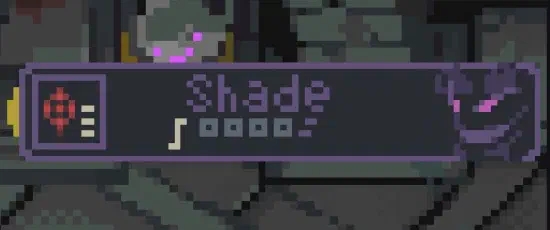
If you take off any of those gray squares, the Shade becomes invincible. Which it currently is.
The strengths and weaknesses of the enemies are the foils to your keywords. quaduse will be your grave when you’re poking Spiker with its high on-hit damage, but a godsent against Hydra, which has a massive 20HP yet dies instantly from any 5 hits in a single turn. Your shields will fail if you let too many Snakes apply poison every round. But for the Fanatic, you’ll want to shield against its highly damaging attacks until it dies from having pain applied to all of said sides. Your heavy hammer doesn’t let you hit 1HP Seeds, which have half their sides dedicated to spawning a Thorn to replace themselves. But it may just take out a Gnoll that your other sides can’t pierce. The Demon has two bits on its HP bar that cannot be removed by spells, inflicts pain, and summons Imps (which in turn deal on-hit damage). The spells can deal with the Imps, but not the Demon. If all your damage comes from spells, or you just lost your last source of dice damage, it’s over.
If your strategy is too focused on one outcome, you’ll eventually run into an enemy that will wreck you specifically. So you must constantly be aware of all the options at your disposal, which options to specifically avoid, what items you have left in stock and if you have anyone better to put them on, what future threats you’re still unprepared for. Whether you can reroll or if you keep what you got to survive this turn and push your luck in the next. Every battle comes with its own problems to solve.
The first large boss you’ll see, the Lich, stays in the backline to spawn Skeletons and weaken you. As you know, Skeletons explode into 1 damage for adjacent monsters, so you’re constantly figuring out how to take out the most skeletons, or if you should waste that effect because one of them is targeting a critical party member that you must save from the brink. As you’re plowing through piles of Skeletons, setting them up to explode in a bone cascade, you leave the Lich exposed, at least until it summons more Skeletons. Maybe you can get a few ranged arrows in, which spawns even more Skeletons at certain levels of HP. And you have to sacrifice a party member, targeted by too many Skeletons, too much weaken coming from the Lich. But eventually, after you break through enough times, victory is yours. Your whole party’s back. And it feels sweet.
And there’s like 14 large bosses.
With so many skeletons to target and explode in various orders, how will you ever find the best one? You already know from other games how difficult it can be to calculate the whole outcome. Not so in Slice & Dice, due to two things implemented to a degree I’d call the gold standard: practically flawless damage prediction, and unlimited undo.
Experimenting freely#
If you’ve ever played Slay the Spire and misclicked a card, potion or prematurely ended your turn, raise your hand. If you’ve ever miscalculated the damage you were about to deal or receive, raise your other hand. Now bend all the way forward and touch the ground in front of your feet, keeping your legs stretched. These are the first steps to the “sun salutation”, which helps improve circulation and flexibility.
I wish I could undo that. I know it’s my fault that I misclicked or didn’t do the math right. Of course you can’t undo a card draw or deck shuffle, that’d be terrible. And it’s part of the challenge to do the additional math, and it feels smart when you get it right. But even knowing all that, it doesn’t take away that it’s still disheartening to lose 40 minutes because I added two numbers wrong. I didn’t know I was going to get shield that round, man, I have like 20 other relics and a day job. I start paying more attention to the math, slow down, wondering if I’m gonna start that run or just do something else that doesn’t wreck my single functioning braincell until I mess up some math again.
Balatro famously doesn’t show you ahead of time what your score is, and intentionally removed it. The numbers and effects are so gratuitous that you have to rough out the numbers eventually, and some of the game’s excitement then comes from not knowing exactly if you’ll make it or not. As soon as you know the exact score count, you lose a part of the game’s identity. But the uncertainty as a feature feels like it’s just triggering the same neurons that would enjoy gambling. Plus, some cards only have some percent chance of going off, making it impossible to get an exact answer.
Adding prediction and undo systems is also hard! Incredibly hard! There’s so many things that can affect any given moment in the average roguelite. Things that will trigger twice, trigger after dealing some amount of damage, when you get hit, enemies will explode and lose their status effects, maybe trigger a few more items, there’s a ton to keep track of, and you can’t miss anything. If you want to get these systems right, it’s gotta be part of the game from the ground up. It’s not something you can easily add after the fact. Did you tie everything to an unmanageable state machine? Forget about it. Monster Train 2 has an undo button which takes a while to process and restarts the fight from the beginning. While I can’t confirm this, I reckon this is because they’re actually restarting the whole game behind the scenes from its initial state. But it does work.
Thankfully, undo and damage prediction is what I’d consider perfect in Slice & Dice. Which is crazy, because some situations can be complex. Is your Tinder going to die the next turn, triggering its on-hit effect dealing 1 damage to everyone? You can see it. Will that effect hit a specific enemy to make them intangible and miss your 5 poison damage? You got it. Hitting another enemy that’ll get enraged and deal more damage as a result, which happens to trigger yet another effect? It’s there. Will this cause another enemy death that will have a Goblin fleeing? It’ll be gently flashing to signify its escape. Applying a shield to Tinder preventing this entire cascade from happening? Oh yeah. You know it’s there.
This, combined with how complete the inventory and character overview is, quickly gives you a clear picture of the game no matter where you’re at, and you can quickly assess what works and what doesn’t. And if nothing works? You can undo everything, and roll again.
Since the randomness is frontloaded, you can lock in your dice and try every combination that can get you out of your current mess. If it doesn’t, hit that free undo button. Undo the last attack, the last 5 attacks, try a different order, a different target. Undo your spells, try different ones, weave them between your dice attacks. If nothing works, undo all the way up to the rolling phase, lock in one or more dice or none at all, and use one of your rerolls. Experiment again. The only thing you can’t take back is the rolls, or certain dice with the sticky keyword (can’t be rerolled once that side comes up).
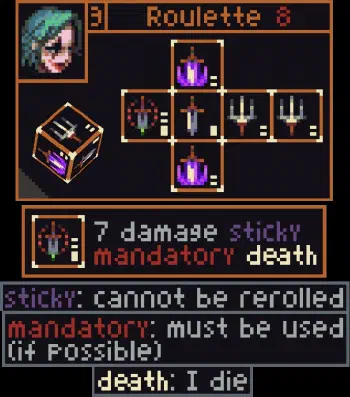
Oh no.
The freedom in experimenting makes a round of combat a playful experience. You can just try things. Does that make the game easy? Far from it. Eventually, every round may kill half or all of your party somehow. It’s just that the complexity lies in dealing with numerous threats simultaneously, finding the best order and the best sides you can. The onus is entirely on the decision-making.
This works because Slice & Dice is so confident in its design. It could easily make the game more difficult by only showing you the targets and having you figure out the aftermath, but it doesn’t need to do that. You have the outcome, and you can figure out the steps to change it. Does that sound like a puzzle game? It kind of is a puzzle game.
Every turn is a puzzle, every battle a separate challenge#
What stands out early are the consequences of a turn and a battle. It’s not uncommon for similar games to have health be the meta-currency you trade in separate rounds, having you assess the right amount of damage to take that’s still worth it. This is more consequential in Slay the Spire and Hades, and still present to some extent in Dicey Dungeons, but you heal/level up often enough for it to be a non-issue.
In Slice & Dice, either everyone dies in battle and you lose the game, or everyone makes it to the next round. Everyone gets fully healed, unless they died once, in which case they get half of their max HP. This also means they get half HP even if you revive and fully heal them, preventing an annoying loop present in some turn based games; dragging out a battle to line up some kind of healing, or stack some stackable effect, because that is optimal play. You have to play optimally in these types of games, but sometimes that really sucks. Cycling your whole deck to stack permanent damage on a specific card sucks. Doing this every battle really sucks. I don’t feel smarter for defending 4 turns until I draw that “gains X damage permanently if lethal” card.
Speaking of dragging on, Slice & Dice also has a neat addition where enemies flee if you’re overwhelmingly ahead, and it’s simple: If your party has 10x the total HP of the enemies’ total, they flee. You don’t have to accept this, or can automatically always accept this as an option. There is no downside to this; it simply saves you from playing out a turn that you are guaranteed to win by the game’s standards. It feels natural, and carefully chosen - you really only see the flee option when it feels like you’ve practically won anyway. It’s a very welcome addition.
Because the consequences for partial failure - some of your characters are damaged or dead - are turned into success, you won’t be wringing out a battle for the last drop of value. There are no permanent damage stackables, no reason to heal for the next battle. A battle draw (e.g. everyone dies from poison) is in your favour, you would win that. Things round up in your favour. If you lose, it doesn’t feel cheap unless you get really unlucky.
The metagame encompassing all 20 rounds lies almost entirely with the choices you make in the rewards after each battle, and how well that prepares you to deal with the various enemies and bosses. And with lower consequences between the battles, you can raise the stakes within the battles. Every battle, and eventually every turn becomes an anime-esque fray where your whole party is battered, bleeding and full of arrows and knives, and you’re like “how are they ever going to recover from this?” And then they recover from it and do it again in the next episode.
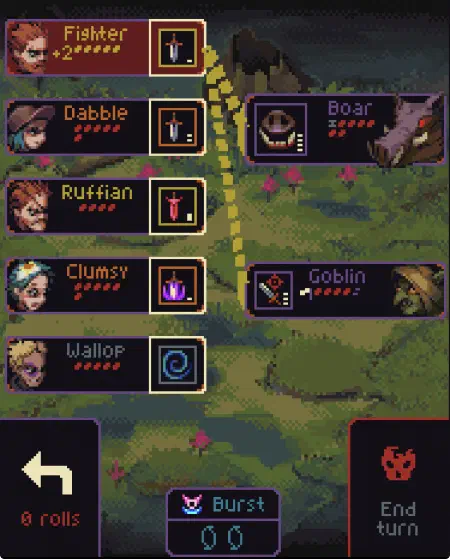
It's the very first turn of the first battle and the Fighter is marked for death, unless you do something about it.
In Slice & Dice, there’s no death by a thousand cuts of mismanaged HP. Early on characters can almost instantly die, as seen in the above screenshot, and later on almost every round of combat can obliterate half your party. You have to pick your targets and rerolls just so that it doesn’t happen. Every round you succeed is a relief, and combat is exciting. No worries about a bad early start because you took 2 hits in the first battle, no need to consider a new run already. You can work with it. The game encourages you to, invites you to. As long as you make it through the battle, the next one isn’t hopeless upfront. And it’s enticing to keep going.
Accessible, approachable#
One thing that I really like is that the game controls are super optimized for comfortable mobile play without making the desktop version feel like a mobile port. If you play landscape, you see your dice rolling on the lush green field. Portrait, the whole UI rearranges and pops out a dice tray that you can comfortably reach. Can’t comfortably reach it? You can scale the UI and dice separately. There’s longpress mode, so you can also reroll by longpressing the bottom right “end turn” button (and conversely end turn by longpressing the bottom left reroll button) - you don’t have to reach all the way over to the opposite corner of your phone, whether you’re left- or righthanded. There’s colorblind options. You can change the font if needed. Nice.
The other thing that makes the game easy to keep picking back up is how seamless saving and loading is - you just don’t. Close the game at any time, any moment you can think of, and it will instantly open again with that exact state. Between battles, halfway through rolling, partially locked in, on the enemy turn, it doesn’t matter and it’s incredibly fast. Within a minute you can open the game, continue for a bit, and close it again. This makes it very easy to play at any given moment. Two stops on the bus or metro? You bet you can finish a battle or two in that time. Microwaving something? For sure you got time.
Of course you won’t be playing for just a minute, but it really is that easy to pick back up. And with the whole state of the game easily readable in a single inventory screen, it only takes a few extra seconds if you hadn’t seen that save file in a month. Every mode and difficulty saves its own progress separately, so you can even reserve the more difficult modes for when you have more time and play the simpler ones on the go. It’s the little things.
The game is also optimized, doesn’t run up your phone’s temperature and doesn’t really drain its battery to support your quest in playing this for stupid amounts of hours. It’s also barely over 100MB. These kinds of optimizations are practically a lost art these days, and really appreciated. You might have forgotten how good it is to have a small and optimized game.
So many ways to play#
Most of this post has been assuming the classic mode, 5 characters, 20 battles. There’s more difficult modes, which show a bunch of different curses at the start, each with their own value (worse effect is higher value), and then you have to pick some amount of points of randomly selected curses to modify your whole game. +1 pip for all enemy sides, enemies can’t die the first turn, one of your dice sides is always blank, 1 less reroll, randomly selected keyword stuck to one or more dice sides, it’s all there. Blessings are the opposite, positive effects, which you get to choose on easier modes below the regular difficulty. The “easy” mode is a bit of a misnomer; you get a fairly small boost and it otherwise plays exactly the same as normal mode, so don’t feel discouraged if you lose that. It’s actually very common.
In between fights, you may also get optional challenges or modifiers. Would you like 4 low tier items, but also be forced to pick a low tier curse? Add monsters to this fight for a greater reward? This too modifies the game in small way, but the impact is immediate. Or you can just decline it.
If you’re tired of that (I’m still not at this point) then there’s a pool of cursed modes, infinite runs that keep piling on curses (and sometimes blessings) that keep screwing with your run, which eventually turns ridiculous. How long can your blessings stack up against bosses with triple damage or an increasing amount of keywords dragging you down?
Then there’s loot mode, replacing all levelups with items, and giving you one extra item slot. With the game balanced carefully around the classes, this can be very difficult. Raid mode, which replaces all items with levelups, doubling the hero and monster count. Choose Party lets you try stupid party setups in the classic mode. Ever wanted to find out how well 5 blue characters fare? Or if there’s some kind of ideal setup out there? And even that is still not even everything.
Infinite ways to play#
If you’re like me (and if so, sorry) you’ll notice that the keyword-based nature of everything would make it easy to shuffle them around for new items and effects entirely. Wouldn’t that greatly extend the possibility space for the game?
It can, and it does. In this game, certain keywords, dice effects or enemy compositions have values attached to them. These values make sure that the new and combined generated thing is appropriately strong for where you’re currently at.
The first way to run into this is by letting you unlock four options that give you a 5% chance of a randomly generated hero, item, monster or modifier whenever their selections come up (and an option to raise that 5% up to 20%). Sometimes you get a choice between a known item or an unknown completely random one. In yet another stroke of design confidence, this doesn’t disqualify you from the leaderboards or some achievement unlocks or anything. None of the options do. Don’t want to wait for all the achievement-based unlocks? There’s a button to unlock everything if you want to dive right into it. Again, no downsides.
Now your already massive choice pools can contain things entirely unforeseen. Due to how their value is calculated, they’ll be appropriate for wherever you’re at. So your games can always have a little surprise, or none at all if you don’t want it. But you’d be surprised how fun it is to keep running into things you’ve never seen before, just occasionally enough to not be overbearing to the balanced main game.
The second way is mod support. Yes, on mobile and desktop. Slice & Dice supports something called text modding, essentially modding and moving around data through long, somewhat readable text strings. This can simply add a few new items, but some truly dedicated players have made entire unique gamemodes with it. Maybe one of them will be your next favourite way to play.
As part of everything being representable through text, this is also how you can have crossplatform progress. Achievements are your unlocks, and you can copy said achievement progress as text on your phone and paste it on your desktop game. You can copy heroes and effects for modding purposes. You can copy your game save as text and send it to a friend. It’s so flexible.
Everything else#
This has turned out way too long, and I didn’t even write about the art and music yet. Your descent from the grasslands, accompanied by an upbeat field march like Ziggurath’s Veteran of a 1000 Rolls, slowly turns into crypts and depths unseen, carried by a synthy dirge like Cold Sanctum’s CONJURING SINISTER WIZARDRY. Which is also a kickass name for a track, everyone should name their music like this (sadly I couldn’t find Cold Sanctum or this specific track online). There’s over 20 tracks in the game, and they’re all spot on, playing at appropriate parts of the game. The character, monster and environment sprites hearken to old, high-quality western RPGs with beautiful graphics, and they hold up great. The Jester’s smug face brings me some joy every time I see it as an option, and I will pick it every time.
I didn’t mention that characters will occasionally throw out a small speech bubble if an enemy is taken out, a roll is terrible, one of them dies or is saved. That’s just nice. It’s one of those touches that makes it feel that extra bit alive.
And I didn’t mention the ingame glossary, containing all the terms, rules, keywords, monsters and heroes you’ve encountered. You never have to bust out Youtube midgame because something defies explanation, it’s all there.
Or when you fire an arrow at someone, it stays stuck in their portrait. Or the lovely UI decision to not shift ally/enemy positions while you’re still in the middle of your actions, so you can rapidly tap your dice and enemies without everything shifting around like a page loading a million ads.
That’s because there’s simply so much in the game, and you’ll discover way more than I’ve written here, from effects to small pleasantries the developer has added throughout. If you’re at all interested in roguelites or turn-based games, I very strongly urge you to try Slice & Dice. You can finish a run faster than this post. It’ll only take a minute. Forever.